

Vietnam runs down the eastern edge of the Indo-Chinese Peninsula in a long S, and that shape matters more to your itinerary than most guides let on. The weather shifts as you move through the country, not as sharply as it does across India, but enough that a good central Vietnam itinerary looks different from a northern one. Central Vietnam stays warm and humid most of the year, which is part of why there is no real wrong season to visit, only better and worse ones depending on what you are after. Da Nang International Airport is the natural entry point from India, though you will connect through Hanoi or Ho Chi Minh City to get there. From here, four stops are worth building a route around: Da Nang itself, Hoi An for its split identity of ancient town and beach, Phong Nha for its cave systems, and Hue, the old imperial capital that most itineraries strangely leave out.
This is the version of Central Vietnam I know two ways: once as an explorer with Udisha, and again covering the same ground with my groups as their tour host. Along the way, I want to flag something a lot of tour operators get wrong. Hue rarely makes it onto Indian itineraries, and that is a real loss, since it holds some of the country's most prominent history and culture. Part of the reason is timing, the sweet spot for Hue falls into a short window, February to April, and most packaged tours are not built around it. I would still make the case for going. Walking through the Hue Imperial Citadel, one of the more striking architectural survivors of the Vietnam War, is worth building a trip around on its own.
The Overnight Bus and a Deck of Borrowed Cards
While on my own trip, Udisha and I took an overnight bus from Ninh Binh to Da Nang and spent the night in the city as a pit stop. Neither of us is big on nightlife or beach clubs, so we spent the afternoon playing cards with a bunch of locals at a coffee joint instead. Most small joints like that keep a deck you can borrow, play, and return. Order a coffee and they will keep your glass of iced lemon tea topped up for free the whole time you are sitting there.
Hoi An, Ancient Town and Beach Town
We did not explore Da Nang much beyond that. Instead we moved on to Hoi An, about forty minutes away, in time to catch its blue hour along with Da Nang's. In total we spent four days near the ancient town and three near the beach. The two halves of Hoi An split cleanly along that line, the beach draws the younger, party-leaning crowd, while the town side suits people who want easy access to the market and the old streets. We liked both halves for different reasons.
Our hostel sat about a kilometre and a half from the ancient town, close enough that we walked in most nights, first to the old streets, then to the night market for the bar scene. Late nights at Tiger Tiger, quick runs to the nearest convenience store for supplies, and one evening a makeshift karaoke session run out of a banh mi cart, are the kind of details you only get by staying that close.
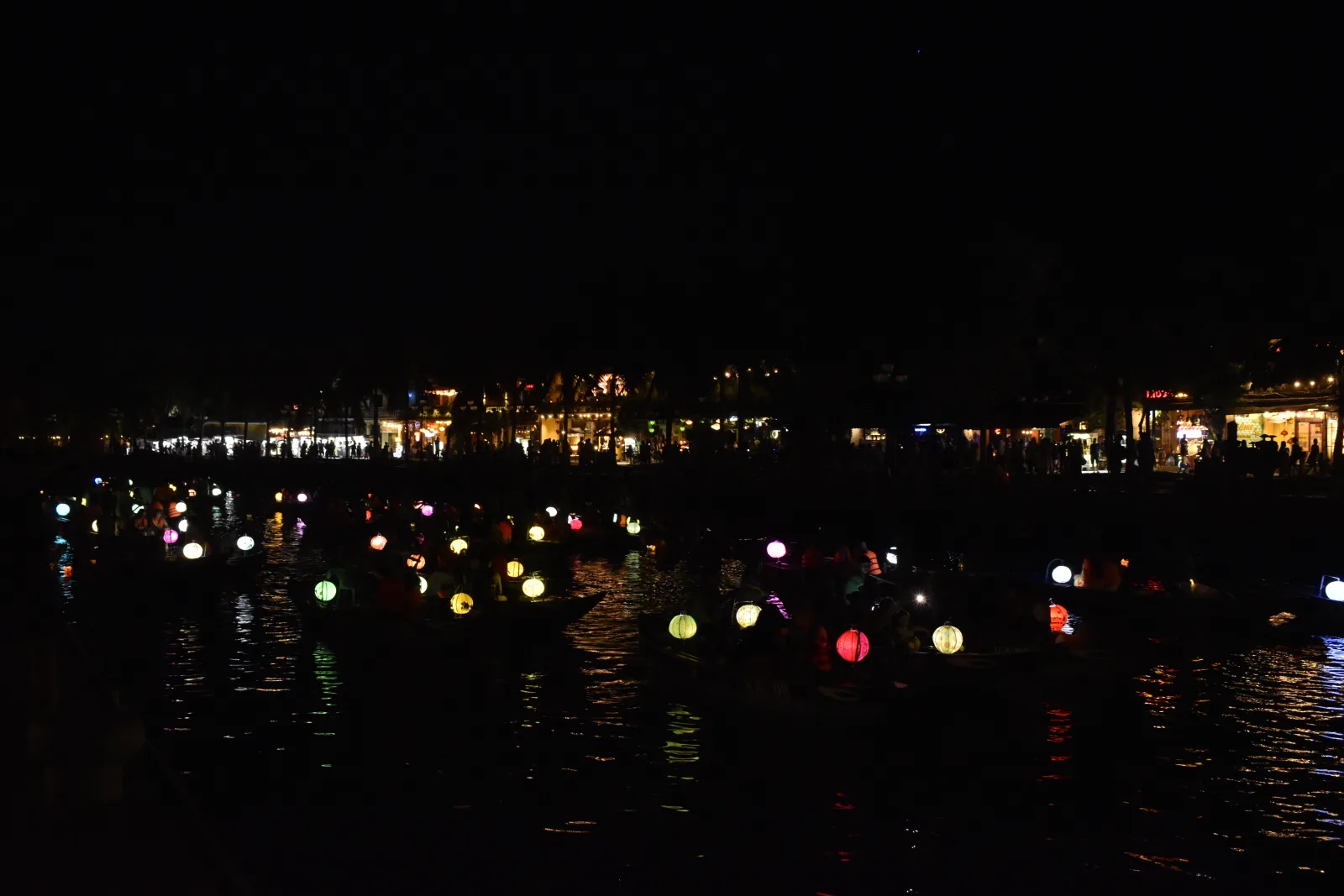
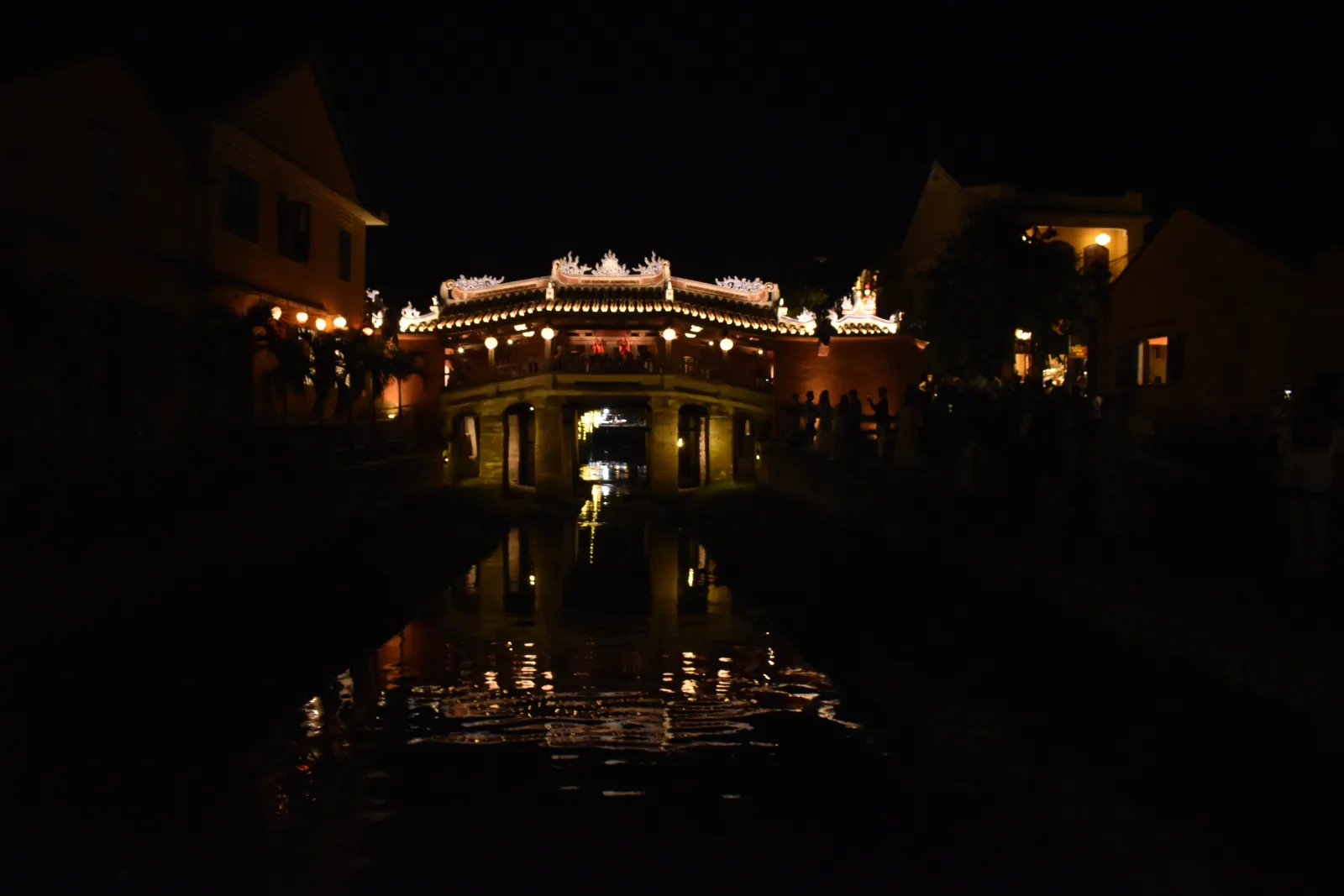
We were lucky enough to catch the night market on a full moon, when the crowd thickens and a small fee gets you onto the Japanese Bridge. Boat traffic on the river is tightly regulated, and it is worth the small charge anyway, lamp-lit boats moving up and down the water while people release paper lanterns downstream for prayers.
The Beach Side, and a First Look at Bioluminescence
On the beach side, we stayed at a hostel built for socialising and spent most evenings on volleyball and pool. The best part, by far, was watching bioluminescence for the first time, the water lighting up with the faintest movement as plankton reacted to it. Neither of us had seen it before, and it is still one of the details from that trip I bring up unprompted.
Choosing the Feasible Excursion
Ba Na Hills and the coconut boat tours were both on the table, but we went with what felt more feasible at the time. Instead of the cable car, we ended up at a nightclub near our hostel in the ancient town, where a group of local strangers pulled us into their hot pot dinner and dancing. It became one of the memories from that trip that has stuck the longest.
As for the basket boat ride itself, the one everyone has seen on video, we did try it, just the version without a formal tour attached. Two to a boat, with someone to row, you get shown how to catch crabs and fold leaf dolls along the way. If your stomach can handle it, ask for the fast spinning version, it costs a little more and is worth it, just hold onto anything loose or it will fly straight into the water.
The Same Ground, With a Group
That contrast became sharp again when I covered the same stretch with a private group, on the leg after North Vietnam. They flew Hanoi to Da Nang, just over an hour in the air, and checked straight into a five-star beachside resort for what became their three days in the centre. One evening was left open to recover, and most of the group used it to sleep in rather than do anything at all.
I am not complaining about the property, it was lovely, but I did feel the itinerary's edges more than I wanted to. Ba Na Hills, though, earns its reputation. The French Village, the Golden Bridge held up by its giant stone hands, the rides, the cable car climbing past 1,400 metres, all of it is genuinely well run. If you do not like crowds, it is worth weighing that before you commit a day to it, and keep in mind the park's own accommodation only makes sense if the weather cooperates for the views.
A local guide through Ba Na Hills, and through the ancient town for that matter, is worth having. They catch details and context you would otherwise walk past. I would still build in your own unscheduled time around the guided parts, that is where the good meals happen, grilled octopus and mi quang at the night market were mine, most nights.
Komorebi Perspective
Central Vietnam gave me a far more touristy read on the country than the north did, and that is not a complaint. A lot of what happens here is built for visitors, and that is fine as long as the place manages it with some care, which it mostly does. If I were sending you, I would build in time for Ba Na Hills, the basket boat ride through the coconut palms, a full moon night in the ancient town, and stints on both the beach side and the town side. Komorebi's approach here is the same as everywhere else we go: give you both sides of a place, and steer you toward the corners that stay quiet even when the main streets do not. Travelling with friends or family, we stitch the whole thing together so none of that planning becomes your problem.

Practical Details
Dry season runs roughly February through August, so there is no real wrong time, though February to April is the sweet spot, mild, dry, and clear enough for Hue's Imperial Citadel and the Perfume River to be at their best. May to August brings the heat and the best beach conditions in Da Nang and Hoi An. September to November turns wet, sometimes heavily so, and is worth avoiding if you can help it.
Da Nang International Airport is the practical entry point, though there is no direct flight from India yet, expect a connection through Hanoi or Ho Chi Minh City.
Split your nights between Hoi An's ancient town and its beach side, they suit different moods and both are worth a few days each. Da Nang works well as a one-night pit stop either direction.
Seven days lets you cover the ancient town, the beach, and Ba Na Hills without rushing any of them. My groups usually get three days here as part of a longer loop through the country, enough for Da Nang and Hoi An, not quite enough for Hue or Phong Nha.
Ba Na Hills sits above 1,400 metres, so the air turns noticeably cooler at the top even on a warm coastal day. Carry a layer for the cable car ride up.
Frequently Asked Questions
Is Central Vietnam suitable for slow travel?
Yes. Hoi An alone rewards a slower pace, since the ancient town and the beach side are different enough to deserve separate time rather than a single rushed day.
What is the ideal duration?
Seven days for Central Vietnam on its own. If it is folded into a longer Vietnam trip, three days is what most of my groups get, enough for Da Nang and Hoi An, not much else.
Is Central Vietnam crowded?
Hoi An's night market and Ba Na Hills both draw heavy crowds, especially around the full moon and on weekends. The beach side and Phong Nha stay noticeably quieter.
Are boutique or community stays available?
Yes. Hostels dominate the budget end in both Da Nang and Hoi An, and boutique beach resorts are easy to find if you want the other version of the trip.
Is it suitable for solo travellers?
Very much so, the hostel scene in Hoi An makes it easy to fall in with other travellers within a day of arriving.
Why do so many itineraries skip Hue?
Mostly timing. Its best window is February to April, which does not always line up with when Indian operators run their central Vietnam tours, so it gets dropped rather than rescheduled.
Komorebi designs thoughtfully paced, culture-first road trip circuits, built around this same idea: enough time to feel a place, not just pass through it.
Planning a longer route? Pair this guide with our Northern Vietnam itinerary and Southern Vietnam itinerary.