
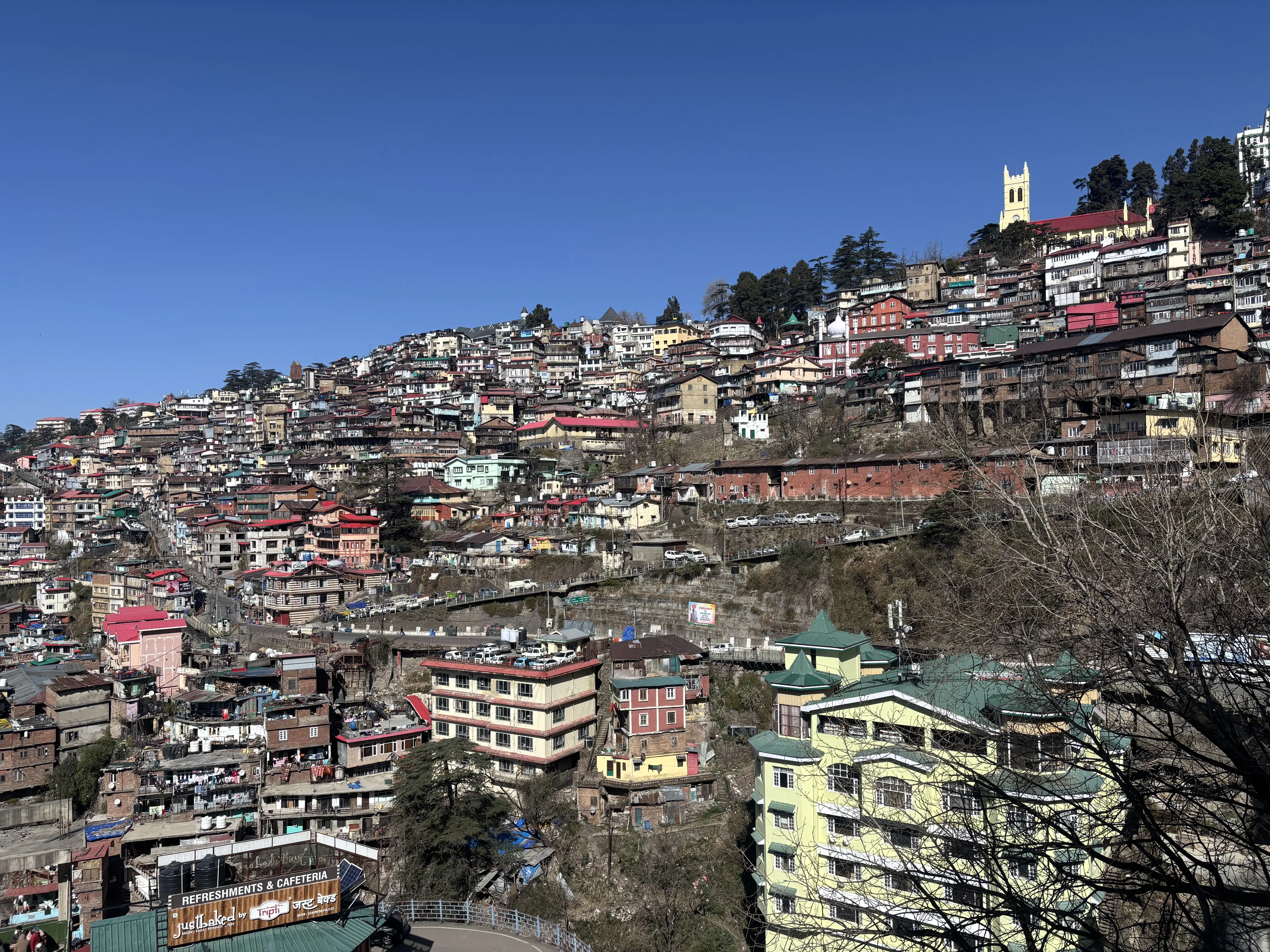
The hill town everyone knows has become harder to love. But the Himachal beyond it, older and quieter, is still there if you know which road to take.
Shimla district recorded about 2.6 million tourist arrivals in 2024. The town itself was built for a fraction of today’s pressure. Something in that mismatch explains almost everything: the traffic, the prices, the water shortages, and the vague disappointment that follows many people home. It also explains why the more interesting Himachal tends to be found somewhere else entirely.
Source: Himachal Pradesh Statistical Year Book 2024–25, Department of Economics and Statistics.
What’s Actually Happening Up There
Shimla was not built for this volume. The infrastructure, the roads, the water supply, and the patience of the people who live there year-round all come under real pressure during peak season. On a long weekend, the town’s parking and narrow roads struggle with the number of arriving vehicles. Residents describe evenings when a drive home takes hours for a distance that should take minutes.
None of this is a reason to stop going. It is a reason to think about how you go, and where.
The travellers who come away most disappointed are not necessarily the ones who expected too much. They are the ones who expected the wrong thing: a quiet hill town, when what they found was a hill town doing its best under considerable strain.
The desire to go somewhere beautiful is not the problem. The problem is thousands of people arriving at the same beautiful place on the same Saturday.
The Himachal Beyond the Ridge
Drive east from Shimla toward Rampur and the Sutlej valley opens up in a way that most visitors never see. The road follows the river for long stretches. Terraced slopes hold apple orchards. Villages use a building technique, alternating courses of deodar and stone, that has been here for centuries and looks unlike almost anything elsewhere.
This is the Himachal that Sarahan belongs to. A town at roughly 2,200 metres, anchored by the Bhimakali Temple complex, surrounded by cedar forest, and operating at a pace not yet reshaped by the pressure on Shimla’s ridge. It is not undiscovered. People know it is there. But the additional drive appears to be enough to keep most visitors away.
A short distance from Sarahan, Rangori is smaller still. Orchards, cedar, and a handful of families whose connection to this stretch of hillside goes back further than anyone can precisely say. Walking through it feels less like visiting a place and more like being briefly admitted to one.
Why the Route Matters
There is a version of Himachal travel that treats the region as a collection of viewpoints connected by hairpin roads. You arrive, photograph, and leave. The place absorbs the visit without giving you much back, and you return with images that look like everyone else’s images from the same spots.
An offbeat route is not just a less crowded version of the same thing. It changes the nature of the experience. When you are in a village rather than a hill station, the interaction is different. The food is different. What you notice is different. The place is not set up to receive tourists in the conventional sense. It asks more of you and gives more in return.
This is not a case against popular places. Mall Road is what it is, and it is not without its pleasures. The point is that Himachal Pradesh contains far more than its most-visited ridge, and much of it is accessible if you stay longer and drive in a direction most people do not.
There is also something worth saying plainly: taking an offbeat route is not, by itself, responsible travel. A village that absorbs a hundred poorly considered visits a month can become the next overcrowded hill station. The point is not to move the crowd somewhere new. It is to travel in a way the place can sustain: small groups, local hosts who are genuine stakeholders, and a pace that leaves room for the community to remain itself.
How Komorebi Approaches This Circuit
The Hidden Hamlets circuit runs for four days. Delhi to Rampur overnight by Volvo, then a shared vehicle up toward Sarahan. Two nights in homestays that are part of the community, not constructed beside it. A full day in Rangori. The return passes through Rampur, with a visit to Padam Palace, the former seat of the Bushahr kingdom, before the overnight bus home.
Groups are capped at ten. The pace is slow by design. There is a Journey Host throughout and Local Hosts in each village: people who live there and are the reason the experience works. They are not guides in the conventional sense. They are the community, and the circuit exists because they are willing to be part of it on their own terms.
The itinerary exists as a rhythm, not a schedule. Day two in Rangori has no fixed sequence because the point of being in Rangori is to be in Rangori, not to complete a list of activities. Orchard walks, cedar forest, and a morning at the Bhimakali Temple when the bells start and the light moves across the Kath-Kuni stonework.
It is, practically speaking, the opposite of the traffic jam on the Kalka–Shimla road. Same region. A different Himachal entirely.
Frequently Asked Questions
Is Shimla worth visiting despite the crowds?
Yes, with adjusted expectations. The old town, colonial architecture, and ridge at dawn still have something to offer. Go in the shoulder season, stay above the main commercial strip, and give yourself time to find the quieter parts.
What makes Sarahan and Rangori different from the usual Shimla circuit?
They are not on the usual Shimla circuit. Sarahan lies several hours beyond the town and is anchored by the Bhimakali Temple. Rangori is a functioning village, not a tourist village. The difference in atmosphere is immediate.
Is the Sarahan and Rangori circuit suited to slow travel?
The circuit is designed for it. There is no checklist of sights to complete. The value comes from spending enough time in each place to move past its surface.
How crowded are Sarahan and Rangori?
Sarahan sees some weekend visitors to the Bhimakali Temple, but nothing close to the footfall on Shimla’s ridge. Rangori is a working village, and you are unlikely to encounter more than a handful of other travellers.
Can solo travellers join the circuit beyond Shimla?
Yes. Komorebi accepts solo bookings on every circuit. Solo travellers join a group of up to ten, supported by a dedicated Journey Host.
What is Kath-Kuni architecture?
An ancient Himalayan building technique that alternates horizontal layers of deodar wood and stone. The structure absorbs seismic movement rather than resisting it. The Bhimakali Temple and ancestral homes around Rangori show the method at different scales.
What is the food like in Himachali homestays?
Himachali home cooking prepared by homestay hosts from ingredients grown or sourced nearby. Expect predominantly vegetarian meals, including siddu, local pulses, and seasonal vegetables. Share dietary requirements with the Komorebi team in advance.
A Quieter Detour
Shimla has not stopped being worth visiting. It is a place that rewards more thought about how you go. The valley beyond it has been waiting, quietly, for people willing to make the detour.
Komorebi runs slow, small-group road journeys across India. Groups are capped at ten, and bookings are open for solo travellers, pairs, and groups of up to three.