
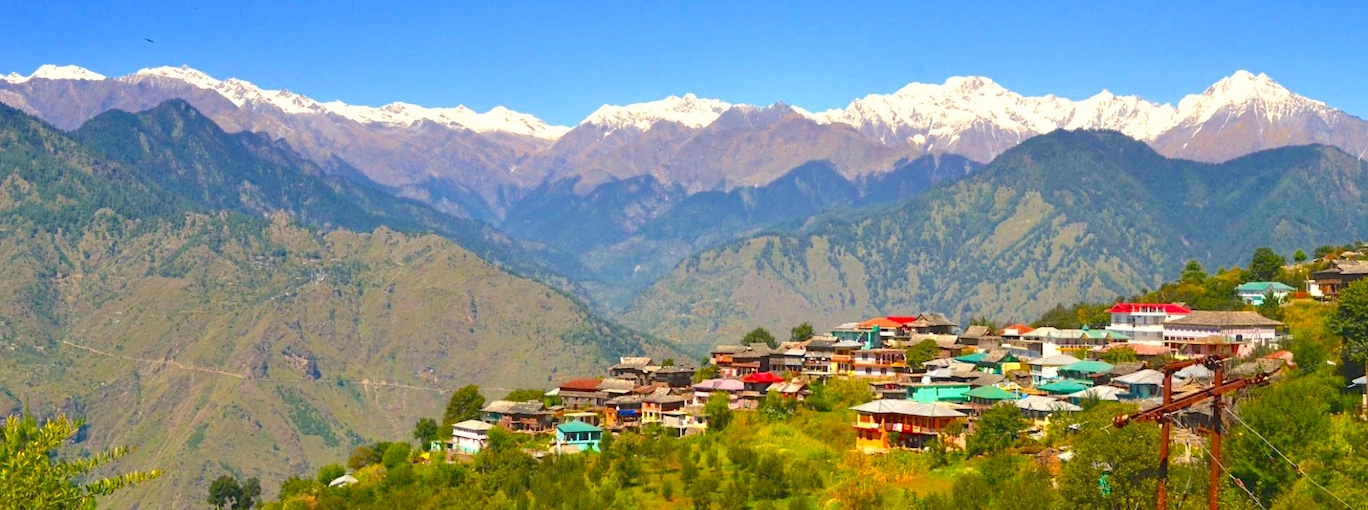
The transition from Delhi to the high ridges of Himachal is not just a change in location. It is a quiet shift in frequency. It begins the moment the city lights start thinning behind you and the long highway stretches into darkness. Somewhere during the overnight ride, the dense warmth of the plains loosens its grip. By dawn, the air has turned sharp and thin, carrying the faint scent of pine.
The mountains do not announce their arrival. You simply notice, at some point, that you are already inside them.
Shimla as a Threshold
When the overnight bus pulls into Shimla, you already feel the distance from the city you left behind.
Mall Road in the early morning has a particular rhythm: shop shutters lifting, thick glass cups of tea appearing on counters, the colonial architecture going about its business with the mild indifference of something that has been standing for a long time and expects to continue. We pause here for breakfast. Not because Shimla is the destination, but because it is the last place that feels recognisable before the road takes you somewhere less familiar.
It is useful as a threshold. You register it, and then you leave it.
The Tempo Travellers pull away from the crowded streets and begin the long climb into the inner valleys. The road toward Sarahan coils along cliffs and through forests, peeling away the noise of the plains with each bend. The landscape grows quieter and more deliberate. By the time the ridge comes into view, the scale of the world has already shifted.
Sarahan: Where the Mountains Are Watchful
Sarahan sits perched on a high Himalayan ridge at 2,165 metres, facing the jagged silhouette of the Srikhand Mahadev peak. The mountains here do not perform. They simply exist, with a steady and watchful presence that you feel before you find words for it.
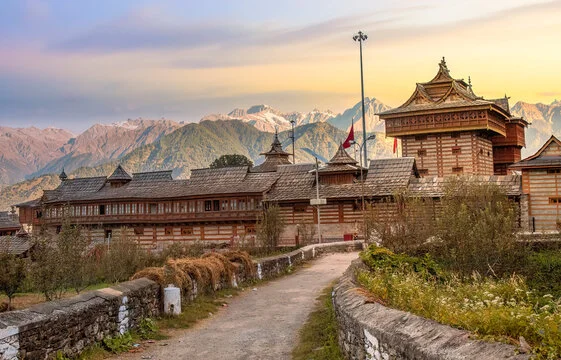
On the first evening, we walk toward the Bhimakali Temple as the sky begins to soften.
What unfolds there is not a performance arranged for visitors. It is the evening aarti, happening the way it always has. Heavy drums echo through the courtyard. Bells crash in steady rhythm. The chants move through the cold mountain air and settle somewhere below the level of the ears, vibrating through stone walls and into the chest. The temperature drops quickly after sunset. The silence that follows has a quality that is difficult to describe and easy to remember.
Morning in Sarahan arrives slowly. Mist lifts from the valley in stages. Sunlight catches the wooden rooftops before reaching the terraced fields below. The mountains reveal their contours again, ridge by ridge. There is no urgency in any of this, and the unhurried pace of it is contagious in the best way.
Rangori: Life at a Different Scale
From Sarahan, the road carries us to Rangori village, and here the polished image of Himachal Pradesh gives way to something more honest.
Life in Rangori moves at a different scale than anything the standard Shimla itinerary offers. Terraced fields stretch across the slopes in the careful geometry of generations of agricultural knowledge. Pine smoke rises from village kitchens. The lanes are quiet in a way that feels inhabited rather than empty, the quietness of a place where people are going about their lives rather than waiting for something to happen.
We spend the day simply being present in it. Walking narrow paths between fields. Watching clouds gather and dissolve across the canyon walls. Sitting with stories that carry the patience of people who measure time in seasons rather than schedules.
The Kathkhooni architecture of the older village structures is worth pausing at here. The interlocking deodar wood and dry stone construction, built without mortar or metal, follows the same logic as in the Kullu Valley villages: a building tradition that has learned to move with the earth rather than against it. In Rangori, these walls are not a heritage exhibit. They are simply the walls of houses where people still live.
By evening, the mountains begin their slow descent into shadow. The light softens across the valley walls and the air turns crisp. Sitting on a wooden porch with nothing but the distant sound of wind through the pines, you start to notice something that happened without your realising it: the urgency you carried from the city has quietly drained away. There was no moment when it left. It simply stopped being there.
Rampur Bushahr: A Gentle Return
The final morning takes us down toward Rampur Bushahr, and into another layer of the region's past.
Padam Palace stands beside the Sutlej, its intricate wooden architecture carrying the memory of a different era of Himalayan governance. Walking through its courtyards is not sightseeing in the conventional sense. The weathered carvings, the deep wooden balconies, the particular dignity of a place that has watched centuries pass without needing to explain itself: these register more as atmosphere than information. You are stepping into a preserved memory rather than examining a monument.
It is a gentle re-entry. Not an abrupt return to the pace of the plains, but a gradual loosening of the mountain's hold, a slow reacquaintance with the idea that the road back to Delhi exists and will eventually be taken.
By evening, the bus pulls away and the mountains recede into darkness behind you.
What Comes Back With You
The highway to Delhi runs long and dark. The city lights appear on the horizon eventually, growing brighter as the plains reassert themselves.
What is different is not something you can easily explain to someone who asks how the journey was. It is a quality of interior quiet that was not present when you left. The echo of temple bells heard in a cold mountain courtyard. The particular patience of a village morning where nobody was in a hurry and nothing required your response.
You did not simply visit the mountains.
For a few days, you moved at their pace. And sometimes that is all it takes for the noise inside to fall briefly silent, which is the closest thing to rest that most of us manage to find.
Practical Details
March to June and September to November. The road to Sarahan can be affected by snow in winter. Monsoon months bring rain and occasional road disruption on the Sutlej corridor.
Overnight bus from Delhi to Shimla, then Tempo Travellers for the onward journey through the inner valleys.
Small heritage homestays in Sarahan with views toward Srikhand Mahadev. Village stays in Rangori for the full experience of the valley's pace.
Four to five days. The circuit is not long in distance but rewards the time to move through it without rushing the mornings.
Sarahan sits at 2,165 metres. The climb from Shimla is gradual but the temperature drops significantly after sunset. Cold evenings are part of the experience here.
Frequently Asked Questions
Is Sarahan suitable for slow travel?
Sarahan is one of the quieter ridge destinations in Himachal Pradesh and sits well outside the main tourist circuit. The Bhimakali Temple, the village life of the surrounding area, and the views toward Srikhand Mahadev all reward unhurried attention. It is a natural fit for the pace Komorebi designs around.
What is the Bhimakali Temple and when is the best time to visit?
The Bhimakali Temple complex in Sarahan is a significant Himalayan shrine dedicated to the goddess Bhimakali, and one of the finer examples of Himalayan temple architecture in the region. The evening aarti is the most atmospheric time to be present. It is a place of active worship, and the experience is shaped by that.
Is Rangori village on the standard Shimla itinerary?
Rangori is not on the standard circuit. Most Shimla-based itineraries stay within the immediate hill station circuit. Rangori requires the willingness to go further and slower. It is precisely that quality that makes it worth going to.
What is Padam Palace in Rampur Bushahr?
The historic palace of the Bushahr royal family, located beside the Sutlej river in Rampur. The wooden architecture is among the more significant heritage structures in the Sutlej valley, and the town itself holds layers of history as an old trade route junction between the plains and the Tibetan plateau.
Is the Delhi to Sarahan circuit suitable for solo travellers?
Yes. Komorebi circuits run with a maximum of ten travellers and a dedicated Journey Host. The group size and structure are designed to make solo travel feel natural and settled from the first day, particularly for those doing group road travel for the first time.
How crowded are Sarahan, Rangori and Rampur Bushahr?
Sarahan and Rangori see a fraction of the visitors that Shimla or Manali receive. The Bhimakali Temple draws pilgrims and a modest number of travellers, but the villages and ridge trails remain quiet. Rampur is a town rather than a tourist destination and has an authentic working pace.
The Komorebi Perspective
Sarahan sits at an altitude and a distance from the main tourist circuits that keeps it genuinely quiet. Most Shimla itineraries do not reach it. Most travellers to Himachal Pradesh have not heard of Rangori. Rampur Bushahr appears in history books more often than on travel itineraries.
Komorebi approaches this region as a living landscape rather than a checklist. The Bhimakali Temple is not a photo opportunity. It is an active place of worship that happens to be extraordinarily beautiful in the evening light. The villages of the inner valleys are not heritage displays. They are communities with their own calendars, their own architectural knowledge, their own relationship with the mountains that surround them.
The circuit is designed for travellers who want to be briefly part of that world rather than briefly adjacent to it.
The mountains between Shimla and the Srikhand range do not ask to be impressive. They simply exist, steadily, at their own frequency.
Komorebi designs for the traveller who is willing to match that frequency, at least for a few days.
Komorebi is a slow-travel design studio running small group road journeys across India. The Sarahan circuit runs with a maximum of 10 travellers and a dedicated Journey Host.
Continue through the mountains with the slow road from Delhi to Kullu Valley, or head east to Meghalaya beyond the root bridges.