Most people don’t go on holiday anymore. They go on a production schedule.
Six cities in nine days. A spreadsheet of reservations before the flight has even been booked. A list of cafés pulled from someone else’s Reel, queued up like a setlist. By the third city, you’re not experiencing anywhere. You’re executing a plan someone else made for engagement, not for you.
We’ve started calling the comedown from this “travel burnout”, as if it is a niche problem. It isn’t. It is the default outcome of how an entire generation has been taught to travel: optimise the itinerary, maximise the locations, and post the proof for a short-lived rush of dopamine.
Slow travel is the rejection of that model. What happens when you stop rushing and let a place unfold?
The Cost Nobody Puts in the Caption
Somewhere along the way, a trip’s worth got measured by its location count. More cities, more stamps, more main characters in the story you tell at dinner. It photographs well. It just doesn’t feel like much.
When every hour of a trip is scheduled, there is no room left for a place to talk back. Conversations with locals get capped at the length of a queue. Meals get eaten standing. By day three in a six-city sprint, the museum and the local market start blurring into the same beige memory.
Ask two people about two very different trips. One spent ten days crossing six cities. The other spent two weeks in a single coastal town, the kind of place we go looking for on our own road journeys through Himachal. The first person gives you a highlight reel: a church, a viewpoint, a meal that was “really good, actually”. The second person gives you a story, usually a long one, with a name in it and a reason you would have had to be there to fully understand the punchline.
That second story is the one anyone actually remembers a year later.
What Slow Travel Isn’t, and What It Actually Is
Slow travel gets reduced, constantly, to “doing nothing”.
Slow travel is staying long enough that a place stops performing for you. It is choosing five days in a single location over five days split across three towns you will mix up later.
It is returning to the same tea stall each morning until the owner stops treating you like a customer. It is picking up four words of a language you may never need again, just because the person teaching you seemed to want to. It is the trail that isn’t in the guidebook because the writer never stayed long enough to find it.
The goal was never to do less. It is to go deeper into less.
Nobody’s Best Story Was on the Itinerary
Think about the travel memory you bring up, unprompted, months later.
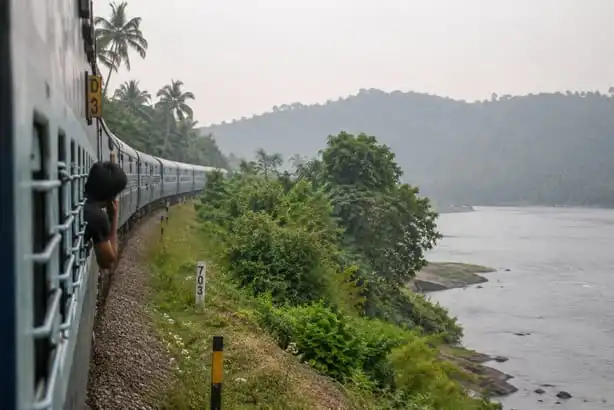
It is rarely the thing on the brochure. It is the four-hour conversation with a stranger on a slow train somewhere between Shimla and Kalka. It is getting caught in the rain near Kaza and ducking into a kitchen where nobody spoke your language but fed you anyway. It is an evening with nothing on the agenda, sitting by a river while the mountains do absolutely nothing in particular.
These moments do not show up when you are trying to manufacture them. They show up in the unscheduled hour. Slow travel’s only real job is to leave that hour alone.
The Komorebi Position on All This
Komorebi, the Japanese word for sunlight filtering through leaves, is the closest thing we have to a mission statement. It is not about chasing the next view. It is about noticing the one already in front of you.
It is why every one of our journeys, whether that is the slow village mornings of Shimla’s Hidden Hamlets or the orchard-and-river rhythm of Beyond the Manali Crowds, is built around time first and distance second. We would rather you remember three real mornings than recall eight blurred ones.
A slow conversation over tea. An evening walk with no fixed route. A stranger’s recommendation that takes you somewhere no listicle would have sent you. These are the only souvenirs that do not end up in a drawer.
Five Ways to Actually Slow Down on Your Next Trip
None of this requires quitting your job or buying a one-way ticket. It requires a different set of defaults.
- Cut a destination; don’t add one. If the itinerary already has five stops, the answer to “should we add a sixth?” is no.
- Stay past the point of comfort. Three nights is a visit. A week is when a place starts letting its guard down and welcomes you into its rhythm.
- Leave a hole in the schedule. Not every afternoon needs an assignment. Some of our best days in Meghalaya’s Khasi heartlands happened because nothing was planned past lunch.
- Walk it instead of driving past it. A street covered on foot reveals more than the same street seen through a car window.
- Go back. The same café, the same ridge, the same family-run dhaba. A second visit, almost anywhere, feels disproportionately good.
None of these needs to justify itself with a photo. That is the point.
Travel Differently, Not Further
Travel burnout was never caused by travel. It is caused by the pressure to see everything, optimise everything, and come home with proof of all of it.
Slow travel measures a trip by a completely different metric: not how much you saw, but how much of it you were actually present for. It is the same argument that sends us back, every season, and keeps us from trying to cover more ground in less time.
Next time you are planning a trip, try removing a destination instead of adding one. You will probably leave with less footage and more to actually say.
Komorebi runs small, thoughtfully paced road journeys across India for travellers who want depth over distance.