
There is a moment, somewhere in the first hour after Delhi disappears behind you, when the quality of the air changes. It does not announce itself. You just notice, at some point, that the window is doing something different, that the light has a different weight, that you are sitting differently in your seat.
The journey into the Kullu Valley begins before the mountains are visible.
Manali as Contrast, Not Destination
By the time the road descends into Manali, the valley floor is already awake. The Mall Road hums with the particular energy of a hill town that has made its peace with being discovered: the organised bustle, the chai stalls doing serious business, the early morning commuters weaving between parked vehicles.
We stop here for breakfast. Not because Manali is the point, but because it is useful as a kind of before photograph. You sit with something warm, watch the town gather itself for the day, and register, without needing to articulate it, why the next part of the journey matters.
Then we leave it behind.
The Tempo Travellers pull away from the bus stand and start the climb. Thirty hairpin bends rising above the river. With each one, the town's frequency drops a register. The honking softens. The walls of the valley open. The road narrows into something that feels less like infrastructure and more like a suggestion.
Sethan at 2,700 Metres
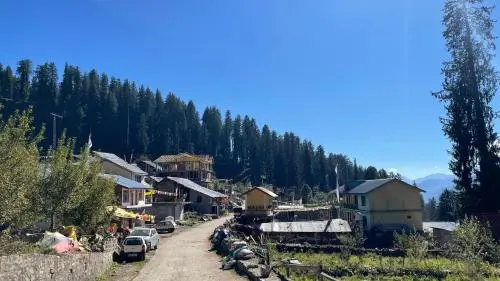
Perched above the Manali noise at 2,700 metres, Sethan is a Buddhist enclave that most visitors to the valley never find. The silence here is not the absence of sound so much as the presence of something else. Wind across the Dhauladhar ridge. The occasional bell. The specific quality of cold that arrives in the late afternoon and reminds you that you are at altitude now, and altitude has its own rules.
We stay in glamping sanctuaries set at the edge of the wilderness, the kind of spaces designed to keep you honest about where you are. Warm inside, genuinely cold outside, the border between the two is part of the experience rather than a problem to be solved.
When the sun drops behind the ridge, the valley below fills with a particular shade of purple that the Himalaya does at this hour and no other. The phone stays in the pocket. Not because anyone has asked you to put it there. Just because the view is not interested in being photographed and you know it.
Rumsu: Where the Building Remembers
The following morning takes us further into the valley's older life.
Rumsu feels like a village that has never needed to explain itself to anyone. The lanes are narrow in the way that old lanes are narrow, not from lack of space but from the logic of a different time, when the width of a path was determined by what needed to pass through it.
The smell registers before anything else. Aged cedar. Woodsmoke settled into stone. The particular damp-and-dry combination of a mountain village that has been inhabited for centuries and carries that history in its walls.
The walls are worth pausing at. Kathkhooni construction, the ancient Himachali technique of interlocking deodar wood and dry stone without mortar or metal, is found across the Kullu Valley, but Rumsu is one of the places where it can still be read clearly. Run a hand along the timber, trace the logic of how one layer sits against the next, and what you are touching is a form of knowledge that is local, specific, and very old. It does not fight the earth. It moves with it. The walls flex slightly in a tremor instead of fracturing. Centuries of Himalayan geology have tested the theory.
This is the kind of detail that does not appear in most Kullu Valley itineraries. It is precisely the kind of detail that stays with you.
Naggar: A Cafe, the Beas, and an Afternoon That Slows Down
From Rumsu, the road carries us toward Naggar.
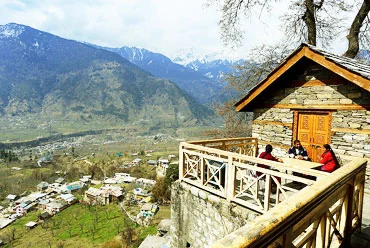
The castle gets most of the attention here, and the castle is worth attention. But we find something more useful on a slow morning: a cafe tucked behind the old stone walls, sun coming through at a low angle, a view down to the Beas River making its way through the valley below.
There is a specific kind of afternoon that mountain travel occasionally produces, where the schedule has been loose enough that nothing is pressing, the place is genuinely pleasant, and the instinct to move on simply does not arrive. This is one of those afternoons. The tea is local. The conversation drifts. The river below does not change but continues to hold the eye.
You stop checking what time it is. Not as a discipline. Just because the information stops being relevant.
The Descent Back Through Old Manali
The return journey is designed to be gentle.
Old Manali, with its narrow lanes and the sound of the Manalsu River running fast beneath the bridges, sits at the meeting point of the mountains and the idea of returning. The coffee here is good. The afternoon is slower than the mornings have been. The mountain energy, a phrase that sounds imprecise until you have spent four days at altitude and felt it leave as you descend, is still present but beginning to thin.
This is the right pace for a last afternoon. Not rushed toward the evening bus. Not holding on to something that is already becoming a memory. Just present in a place that is pleasant, watching the light change, understanding that you are about to return to the city as a slightly different version of the person who left it.
The bus pulls away in the early evening. The valley closes behind you. What you are carrying back is not a photograph collection or a list of places visited. It is something harder to name, a shifted sense of frequency, the memory of silence that cost nothing and required only the willingness to sit inside it for a few days.
Practical Details
Late September to early November and March to June. Winter at Sethan is cold and quiet in a way that rewards those prepared for it.
Overnight bus from Delhi to Manali, then Tempo Travellers for all in-valley movement.
Glamping sanctuaries at Sethan for the wilderness edge. Small homestays in Rumsu village for the full Kathkhooni experience.
Four to five days to move through the valley without rushing any of it.
Sethan sits at 2,700 metres. The climb from Manali is steep and the temperature drops significantly after sundown. Pack for cold evenings regardless of the season.
Frequently Asked Questions
Is the Kullu Valley suitable for slow travel?
The Kullu Valley is one of the more naturally paced regions in Himachal Pradesh. The valley rewards those who move through it without urgency. Sethan, Rumsu, and Naggar are all small enough that the experience is defined by quality of attention rather than volume of sights.
What is Kathkhooni architecture?
Kathkhooni is an ancient Himachali building tradition that uses interlocking layers of deodar wood and dry stone without mortar or metal. It is found across the Kullu Valley and represents a form of seismic-resilient construction developed over centuries of living with Himalayan geology. Rumsu is one of the clearest places to see it intact.
Is the Kullu Valley circuit suitable for solo travellers?
Yes. Komorebi circuits run with a maximum of ten travellers and a dedicated Journey Host. The group size and structure are designed specifically to make solo travel feel settled rather than uncertain from the first day.
Are boutique or heritage stays available in the Kullu Valley?
The accommodation is chosen to reflect the character of each location: glamping spaces at the edge of the Sethan wilderness, small village homestays in Rumsu. Neither is a hotel in the conventional sense, which is precisely the point.
How crowded are Sethan, Rumsu and Naggar?
Sethan and Rumsu sit outside the main Kullu Valley tourist circuit. Manali is busy, which is part of why we use it as a point of contrast and then leave it. The rest of the circuit is quiet.
What should I pack for Sethan?
Warm layers for evenings at altitude, good walking shoes for uneven village lanes, and a genuine willingness to be offline. The cold at Sethan is the real kind.
The Komorebi Perspective
Komorebi approaches the Kullu Valley not as a sequence of viewpoints but as a living landscape with its own interior life.
The Kathkhooni villages. The Buddhist enclaves above the tourist line. The cafes that nobody queues for. The afternoons that have no agenda. These are not the hidden gems of travel marketing copy. They are simply what the valley looks like when you move through it at the pace it deserves.
This circuit is designed for travellers who want the Kullu Valley to be a place they have been rather than a destination they have covered.
The Kullu Valley does not ask you to be impressed by it. It asks you to slow down enough to notice it.
That is a different kind of journey. It is the one Komorebi designs for.
Komorebi is a slow-travel design studio running small group road journeys across India. The Kullu Valley circuit runs with a maximum of 10 travellers and a dedicated Journey Host.